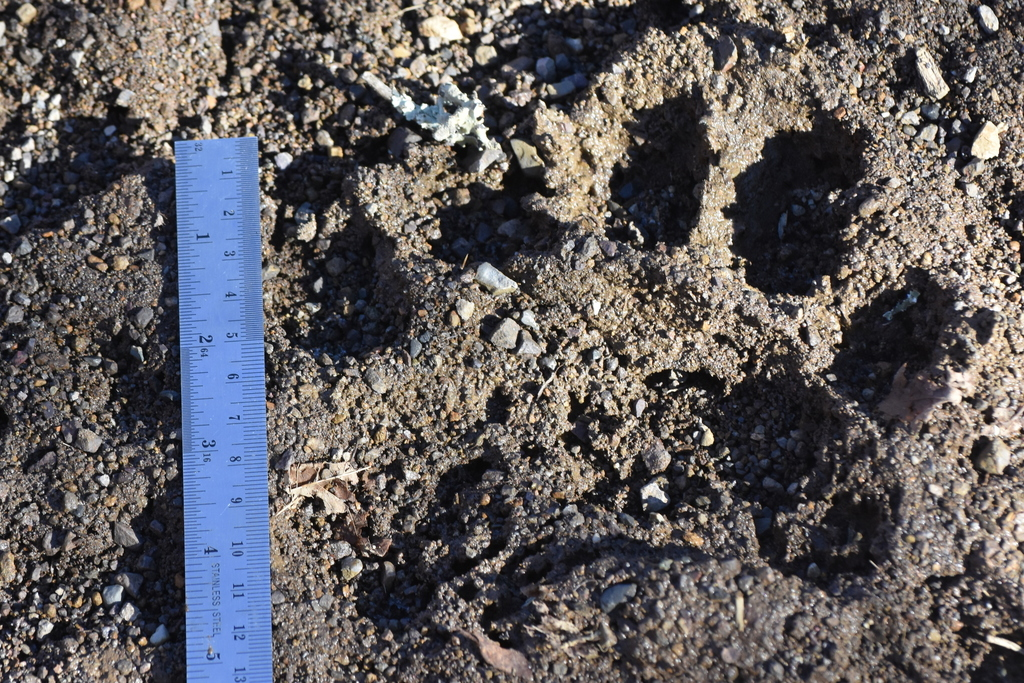
A large American Black Bear (Ursus americanus) track near Scales Campground.
“Wilderness is not a luxury, but a necessity to the human spirit” - Edward Abbey
How many kids have the ability to experience wilderness, a place where they are able to interact with flora and fauna in a safe, educational setting, while they still have the freedom to explore? In our opinion here at the Blue Ridge Discovery Center, not enough! One of my favorite stories to describe just how impactful our outdoor environmental education experiences can be involves an enthusiastic kid and a special encounter with Southwest Virginia’s largest native carnivore.
In 2021, in the first year of Wilderness Expedition backpacking camp I had the privilege of guiding, we had one camper who was particularly interested in learning how to find wildlife. Personally, I had been delving back into the tracking guides of Tom Brown Jr., who writes detailed ways to understand animal behavior through the tracks and signs they leave behind. A website I learned about when I was the age of many of our campers, which had a strong bearing on the trajectory of my life after that, was built with input from students of his “Tracking School” (the website is here: https://wildwoodtracking.com/) He uses scientific methodology to understand gaits, speed of walking, injuries, direction, which way the animal’s head was pointing, and then even some more controversial hints about understanding the mentality of the animal and predicting what it’s going to do.
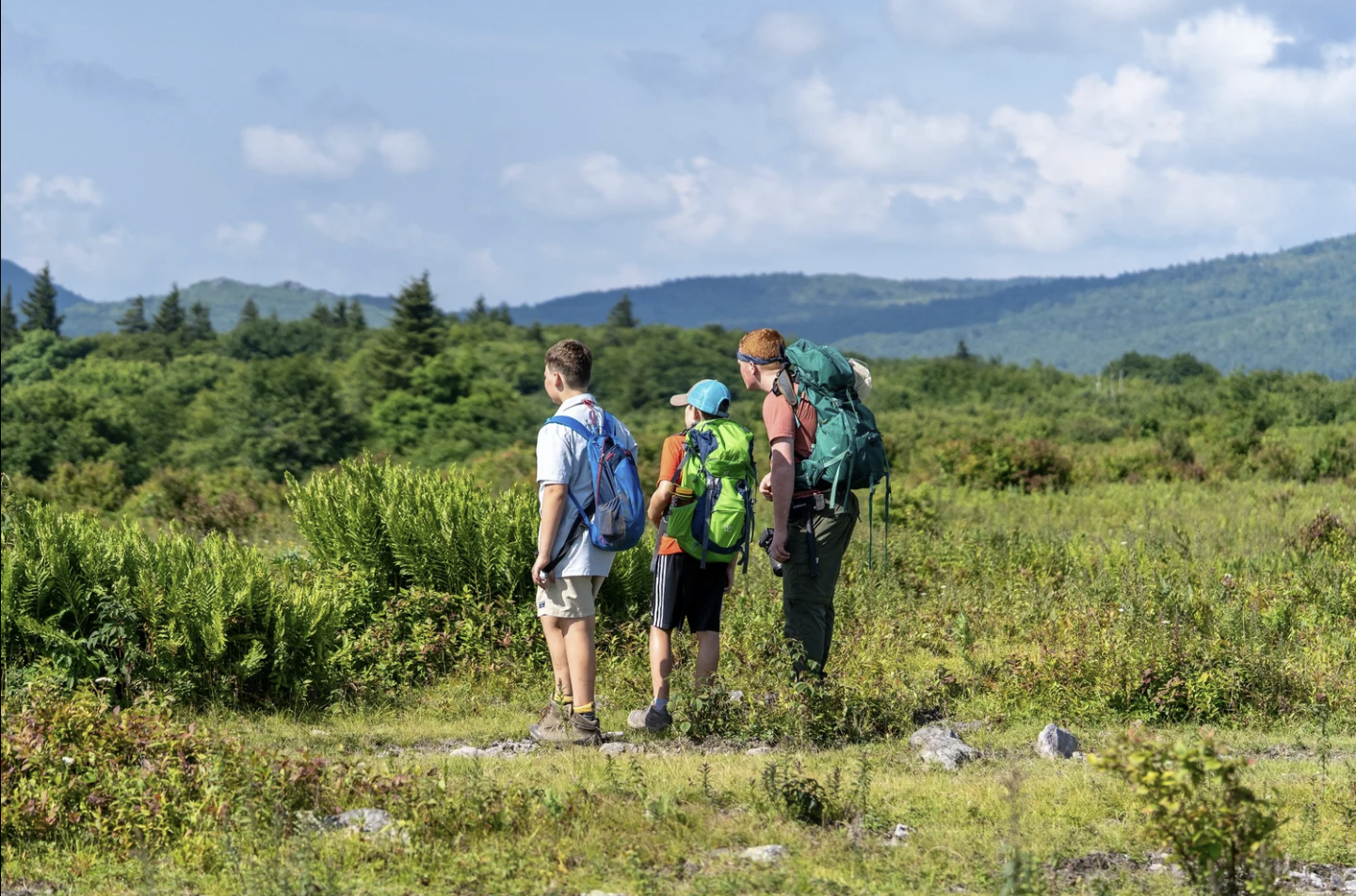
Scanning for wildlife in the distance while the rest of the group stopped for a snack.
Inspired by my readings, and engaging what Brown’s teachings call “dirt time” practicing a more detailed form of wildlife tracking, I decided to start our first hike of our backcountry expedition strong with tracking tips on the way to explore the headwaters of Big Wilson Creek. One kid in particular, named Trevor, was uniquely interested. We happened to stumble across some fresh bear scat, steaming on the trail. I showed all of the campers how we could “dissect” it from a distance with a sturdy branch, and see what the bear had been eating. There were blackberry seeds, blueberry seeds, and an assortment of wild black cherry and pin cherry pits. This bear was clearly taking advantage of the mountain’s delicious, sugary bounty in the late summer, feasting while enjoying the views. As a result, it was playing an essential role of a guerilla gardener on the mountain, leaving behind seed mixes imbedded in some of the most smelly but effective compost that will nurture the seedlings of berry bushes and fruit trees native to the high country.
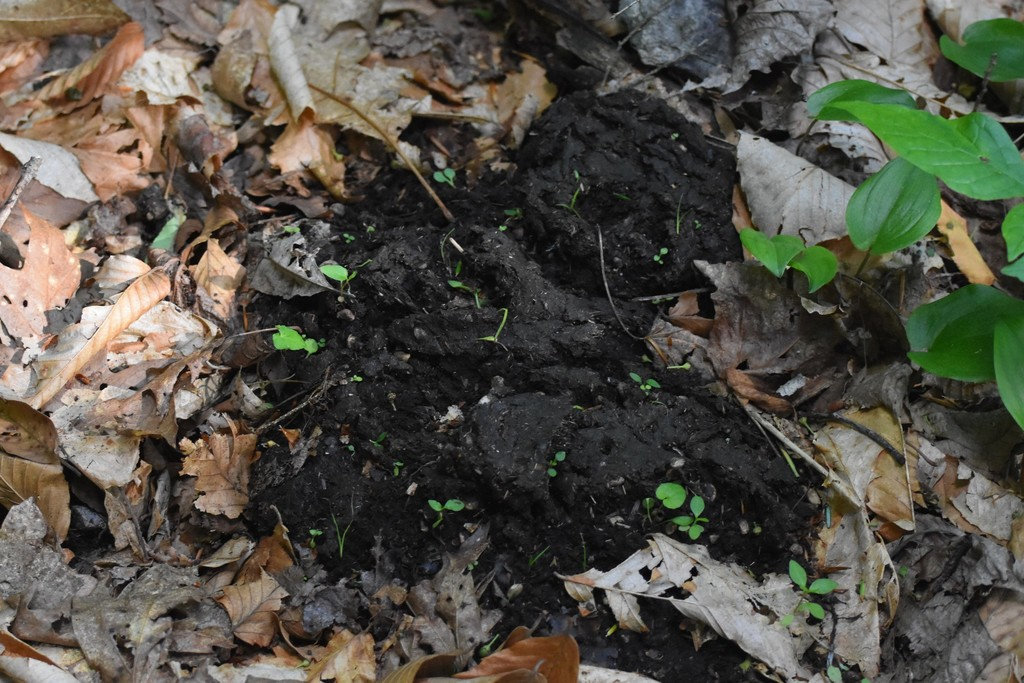
Seeds germinating from bear scat in the Mt. Rogers National Recreational Area.
We were able to find some bear tracks in the nearby mud, spanning nearly six inches across with long claws imprinted carefully in the sand. The experience sparked Trevor to constantly stare at the trail. In every subsequent hike, through the Little Wilson Creek Wilderness and the Lewis Fork Wilderness, his eyes were glued to the trail and the wet mud near it. We found tracks from most of our native mammals, from paths of wood frog tracks to white-tailed deer scrapes on trees. Bobcat scat on giant boulders used as latrines, ruffed grouse feathers left behind where they were flushed on the trail. We saw a variety of bolder wildlife, from Southern Appalachian Red Squirrels (Tamiasciurus hudsonicus abieticola) known historically as “mountain boomers,” for their loud, rattling scolding calls to the echoing songs of coyotes at night.
As many adventures as we had, and no matter how exciting the conversation and games the group played got, Trevor would always snap back to focus on tracks - and to ask me incessant questions about them.
“Was this deer running?”
“Will we see a bear?”
“Do you think this is a chipmunk burrow?”
“I really want to track down a bear!”
“Was this coyote’s head turned to the left?”
“Will we see a bear?”
Of all of the different mammal signs we saw, salamanders, blue burrowing crayfish, rare plants, giant mushrooms. Of all the rocks scrambled, creeks forded, meadows frolicked, and rhododendron thickets explored, Trevor was laser-focused on the tracks and signs of one species: the American Black Bear (Ursus americanus).The questions were relentless. Anyone can agree that the bear is probably the most charismatic animal of the Southern Appalachian Mountains, from the Smokies northward. But it became an obsession. In the process, Trevor was gaining the skills to identify not only bear signs, but the signs of other animals as well. He recognized what animals were likely doing (traveling to drink water from the creek, feeding on spruce cones on a stump, evidence of wild mice in the coyote scat in the meadows).
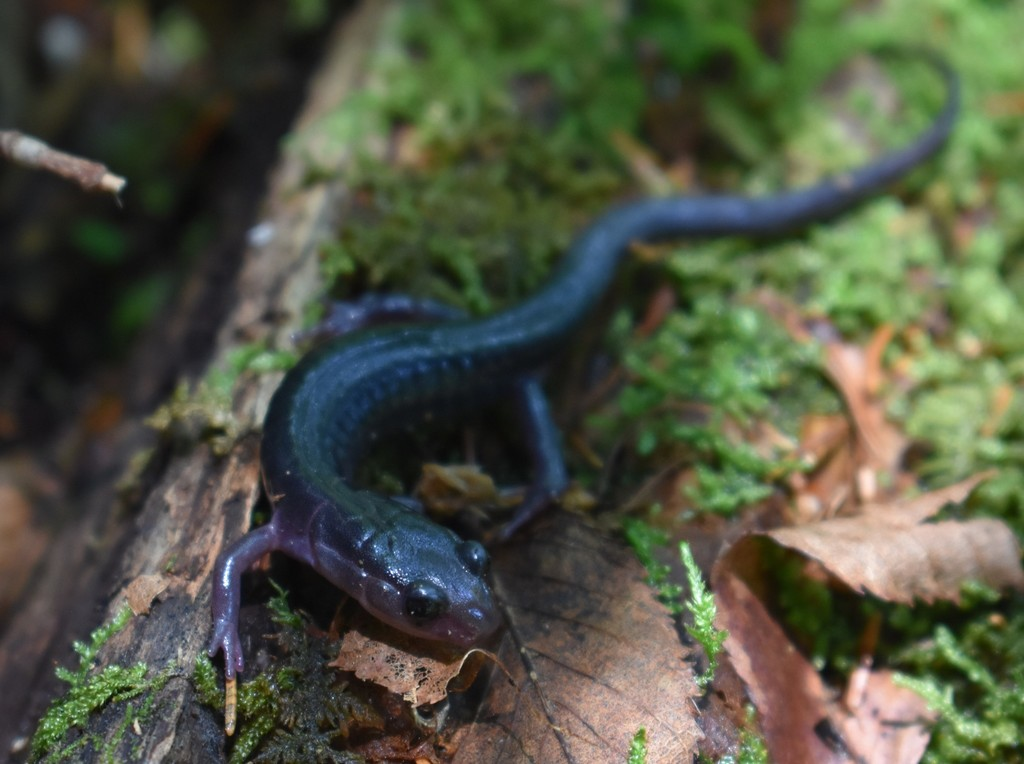
A Northern Gray-cheeked Salamander (Plethodon montanus) we found, whose scientific name loosely means “The Many-toothed Creature of the Mountains.” It is found only in the Blue Ridge, from Mt. Rogers to Roan Mountain.
On our final day, the group hiked to Mount Rogers, camping at the base of the spur trail near Briar Ridge where wild ponies and free-ranging longhorns graze. Trevor continued to look for bear tracks and signs all the way up to the summit of Mt. Rogers, and back down. On the way back on the last day of camp, I was leading the group back to our base camp to load into the vehicles and head back to the Discovery Center. Trevor was walking just behind me, at the front of the charge. Even in the height of summer, the mountains are still chilly in the morning, and the sun was not yet up. Half-asleep, we all wandered slowly through the misty woods hearing the final chorus of hermit thrushes for a while.
Trevor was as lively as ever, determined to see a bear. He was following tracks that occasionally appeared on the trail, going the same direction as we were. “These look really fresh! They look like the ones you said mean that a bear passed by in the past hour or so.” Happy he was enthused, but also not wanting to get his hopes too high, I told him that there was a bear that probably walked our same path. I wanted to make that seem really special; partially because it is, but also to keep him from being disappointed when we (statistically) were not going to see a bear before leaving the high country.
As we continued, he got more and more confident that these tracks were going to lead us to a bear. Despite being tired, we were still pretty noisy. Camp-delirium-fueled jokes and laughter would have alerted any bear to gallop away, off of the trail and into the dawn forest. We finally reached a spot where the bear tracks were really fresh. I was beginning to feel bad for Trevor’s fruitless search. “It’s gotta be close!” he said, but I was doubtful.
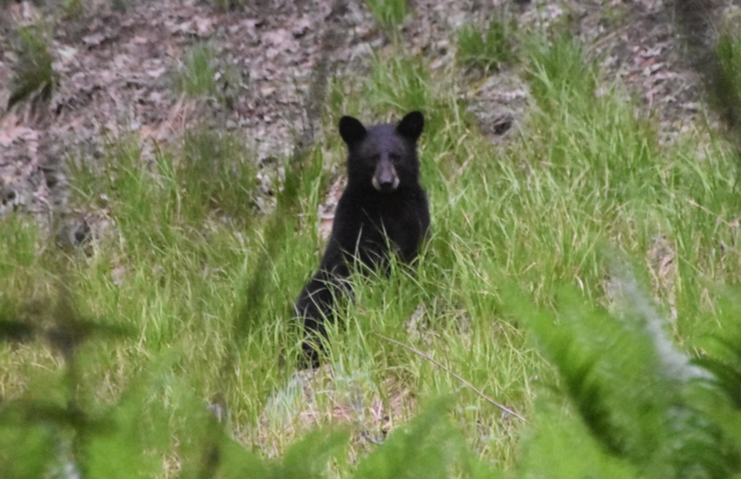
A yearling American Black Bear (Ursus americanus), much lankier, more curious and with taller ears than an adult. After leaving their mother and siblings, they must roam great distances to find a new territory in the Blue Ridge Mountains.
Instantly, we heard footsteps crashing in the open forest, and as the first rays of sunlight struck through the trees, there was a yearling American Black Bear running through the woods. He ran straight across the trail and downhill into the hobblebush below. We watched him for around thirty seconds as he bounded across the open plateau of birch and beech trees, and he gave everyone a chance to watch as he vanished into the underbrush. I looked at fellow guides Lisa and Abby, who was firmly clutching a canister of bear spray, and we were awestruck. It was the first time we had seen a bear on foot during this camp. Was it luck, or had Trevor’s devotion to tracking led us to a bear? Maybe it was more metaphorical, like what Tom Brown taught for all those years; the “dirt time” paid off.
Get out there. Explore the woods. There is always something to learn. When kids are given an opportunity to explore, and the knowledge they need to understand the natural world around them, the world becomes a better and more understanding place to live.