
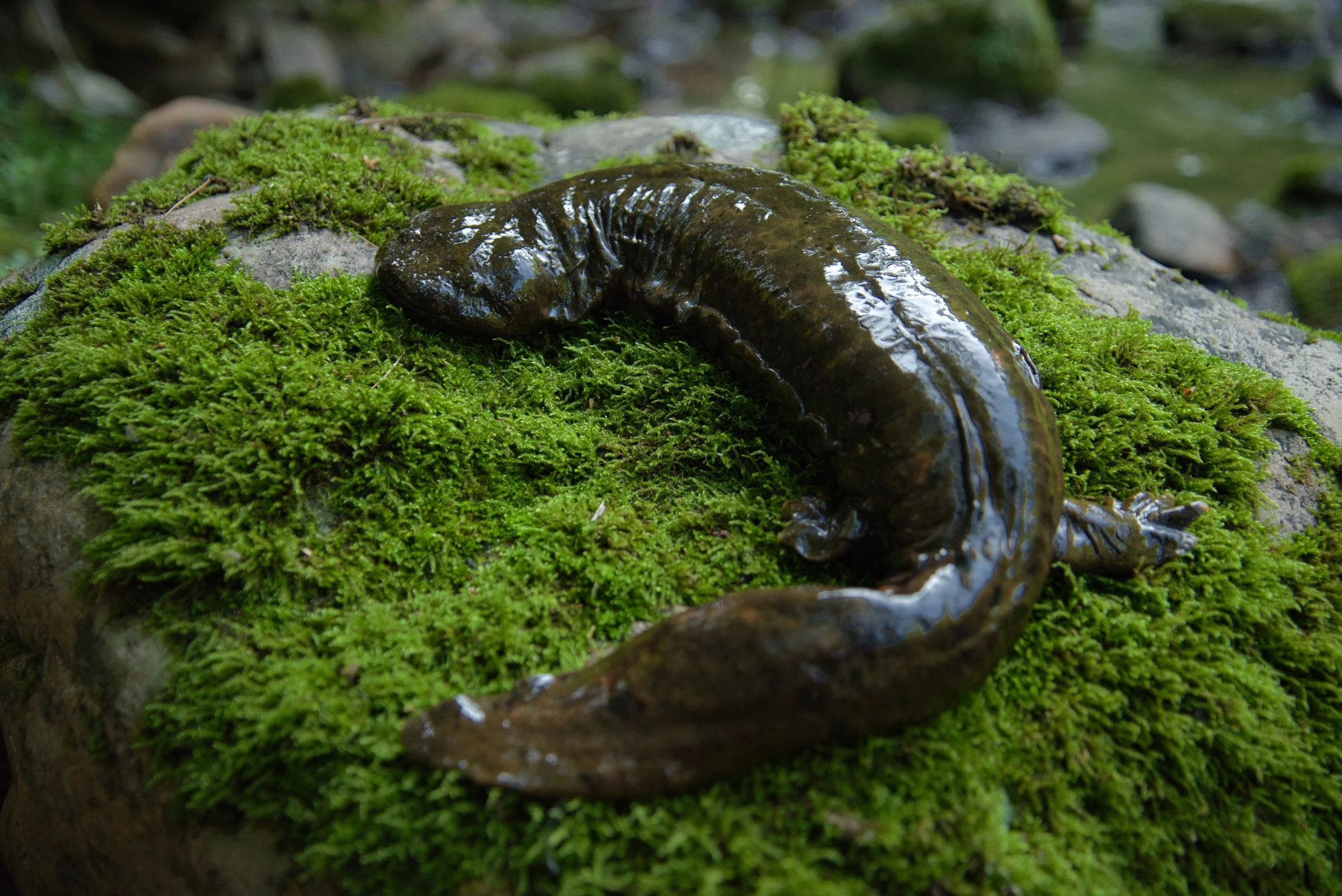
Hellbender. Sounds like something out of a horror movie, right? With a flat head, tiny eyes, wide mouth, and long wrinkly body, hellbenders are certainly misunderstood and undervalued for the marvelous critters that they are–a unqiue regional treasure and an indicator species to overall ecological health.
Post Hurricane Helene and its devastating impact on southwest Virginia that began in late September of last year, people have been more curious than ever about what hellbenders are and how these animals are doing in the wake of such an unprecedented natural disaster.
So, let’s dive in.
What is a hellbender?
Hellbenders (Cryptobranchus alleganiensis) are a species of salamander belonging to the family Cryptobranchidae–the family of giant salamanders. There are only three species of giant salamanders, and the hellbender is the only species in the western hemisphere.
How big do hellbenders get?
Hellbenders are characterized by their large size, mottled red-brown to tan coloration, flat heads, keeled tails, and long stretches of folded skin (called frills) running down each side of their bodies. They use these frills to increase their skin’s surface area to absorb more oxygen, which is the main way they breathe as adults.
Most hellbenders fall in a size range of 11.5 to 20 inches, or about one to two feet in length. The average weight for a full-grown adult hellbender is around three pounds. Some hellbenders have been reported to grow much larger than this: the largest on record was a 29.1-inch female (nearly two and a half feet long) and weighing almost five pounds!
When hellbenders are first born they are tiny–only one to two inches long. While hellbenders grow rapidly in their first year of life, they don’t reach their adult size until they are about six years old.
How long do hellbenders live?
Hellbenders are very long-lived, reaching 25 years of age on average in the wild and living longer in captivity–the oldest captive hellbender lived to be 29 years old! Some studies suggest that the wild their lifespan may be even longer–up to 50 years–but this has yet to be proven.
This long lifespan is accompanied by a long developmental period. Hellbenders live as larvae for about two years before they finally start to metamorphose into their adult form, lose their external gills, and begin breathing through their skin. It takes hellbenders between six and eight years on average to reach sexual maturity and begin reproducing, which makes it a difficult task for most young hellbenders to actually reproduce.
What do hellbenders eat?
Hellbenders eat almost exclusively crayfish, specifically crayfish that have just undergone molting their exoskeleton and are still soft and squishy. They do tend to branch out and try other foods on occasion, including small fish, various insects and arachnids, snails and slugs, and other amphibians such as tadpoles, small frogs, and other salamanders–even other hellbenders! Under periods of high food stress, it has been found that hellbenders will become more cannibalistic and sometimes males guarding a clutch of eggs will resort to devouring their own young.
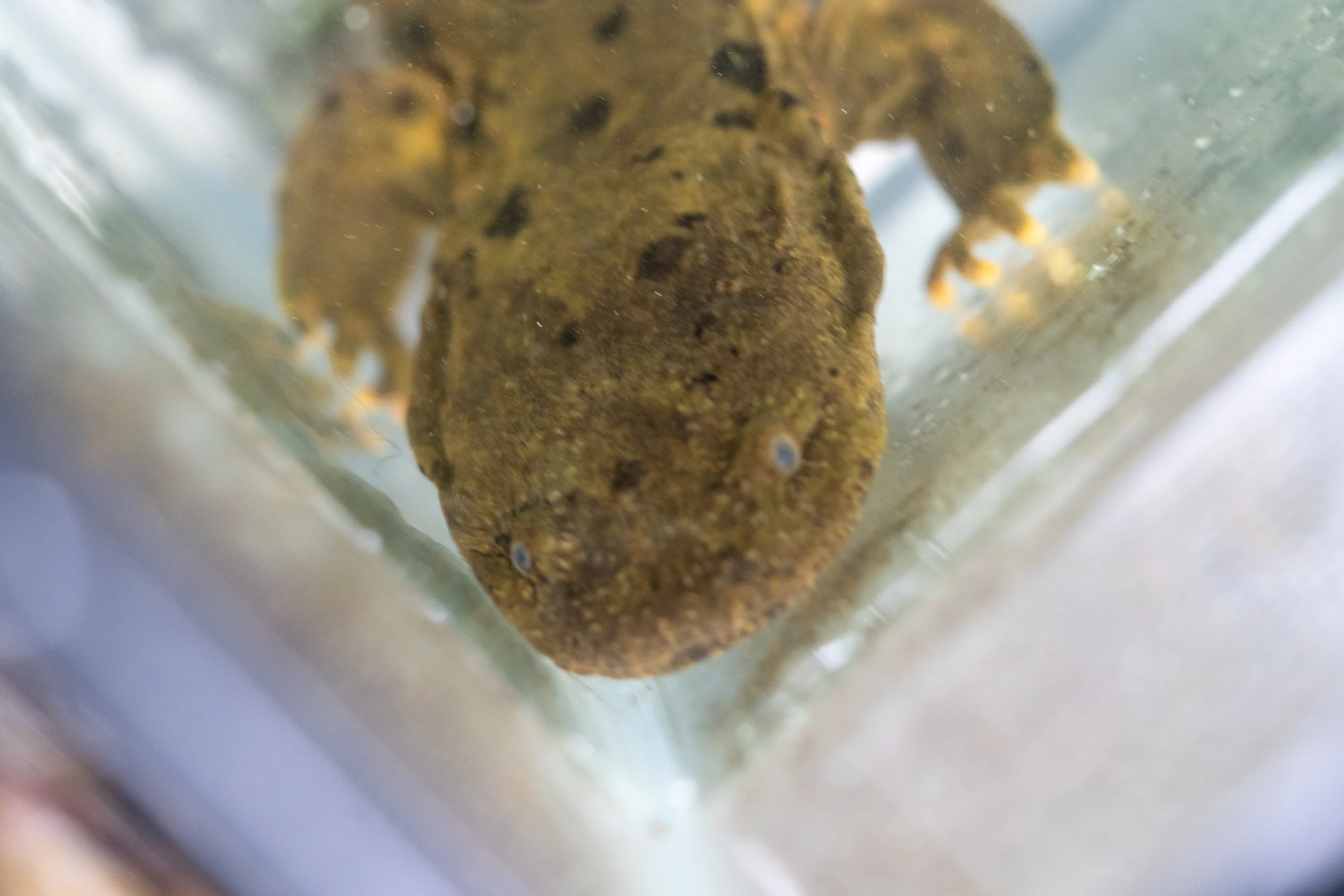
Lasagna Lizard, Snot Otter, Devil Dog: the hellbender has many names, and none of them very nice!
The infamous “lasagna lizard” of the Appalachian Mountains
Hellbenders are native to cold, mountain streams and rivers within the Appalachian Mountain region, ranging from southern New York down to Northern Georgia. In Virginia, they can only be found in the southwest corner of the state.
Hellbenders prefer clear, fast-moving streams and rivers that have high quantities of dissolved oxygen. The preferred streambed substrate is one that has ample gravel, sand, and numerous large, flat rocks for the males to make their dens and nests under.
Here’s a fun fact: while hellbenders predominately breathe using their skin, they still have lungs. These lungs are used for buoyancy rather than breathing, similar to a swim bladder that many fish have.
Hellbender habits
Like most salamanders, hellbenders are nocturnal. They spend the day resting under large rocks or in their dens and come out at night to hunt for crayfish, which are also mostly nocturnal.
Hellbenders are solitary for the majority of the year up until late fall when the breeding season begins. Males will migrate several kilometers to find suitable nesting sites, and some areas with a lot of these sites can see congregations of up to 10 hellbenders at a time.
The males will create a nest underneath a large rock or pile of rocks and wait for a female to come along. She will lay a clutch of around 300-400 eggs on average–and sometimes up to 1,000! The male will then fertilize the eggs, making hellbenders one of the few species of salamander that actually utilize external fertilization rather than internal. The male hellbender stays with the eggs and defends them from fish, turtles, and even other hellbenders through the winter until the eggs finally hatch in the spring. Hellbender fights are not uncommon and older hellbenders can be seen with many scars from their years of defending nests.
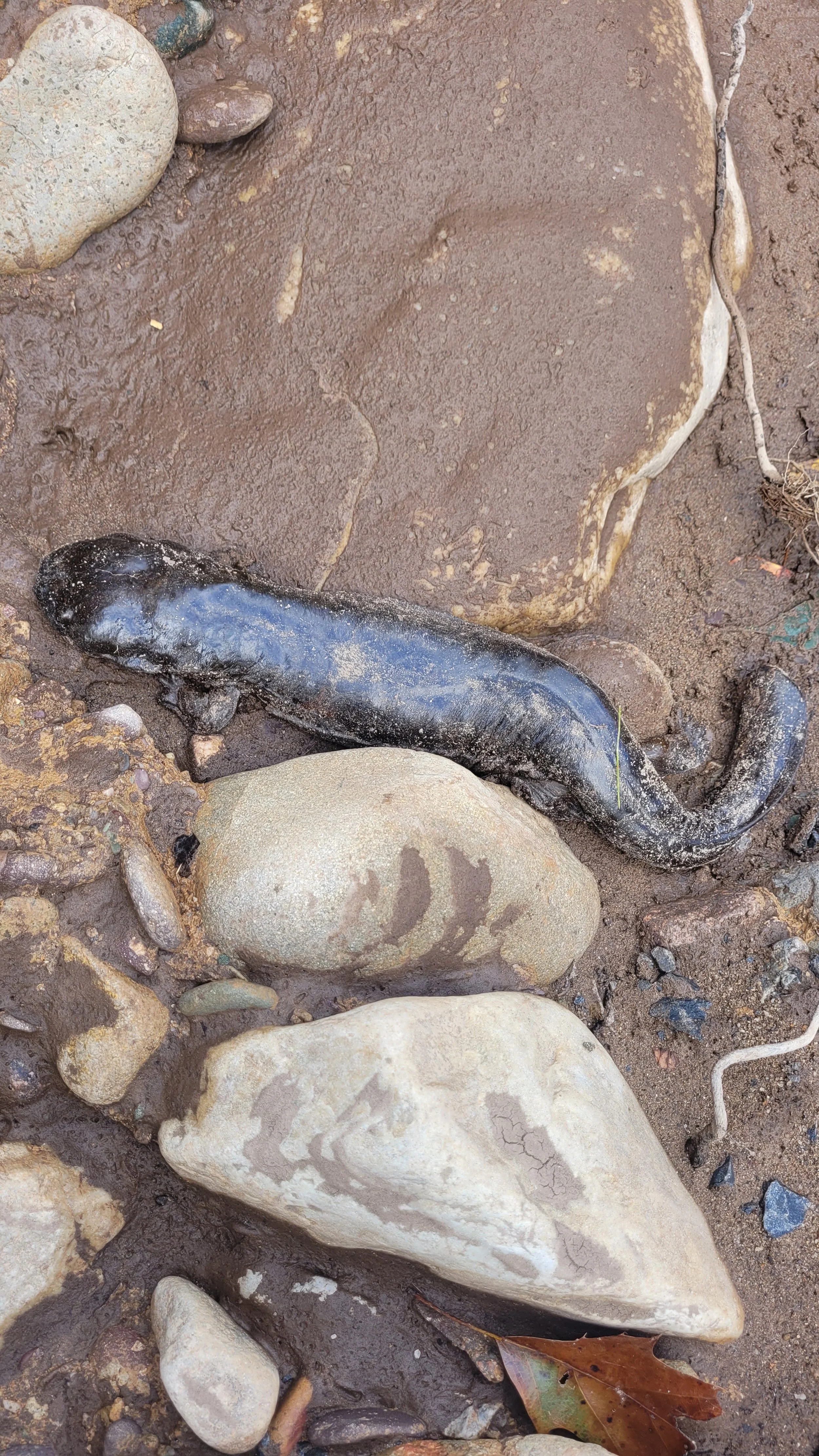
During the flood, this hellbender was trapped in a small pool of water that slowly receded until there was no water left.
The importance of hellbenders to the ecosystem
Hellbenders are one of the best environmental indicator species in their range, since they require healthy streams to survive. A degraded stream will see sharp declines in hellbender population numbers, acting as an alarm that the stream has something harming it and that it needs to be monitored.
Hellbenders also play an integral role in the food chain: they are the dominant predators of crayfish in their range and help control crayfish populations. When crayfish populations grow quickly and unchecked, they begin to devour and raid nests of fish eggs, directly reducing native fish populations.
Threats hellbenders face
Hellbenders are mostly impacted by declining stream health. Actions that have degraded healthy habitats for hellbenders include obstruction of waterways via dams, increased quantities of pollutants in freshwater ecosystems, and siltation. Siltation is likely the most imminent threat to hellbenders, as human land development has caused highly erodible conditions along stream banks, leading to immense amounts of sediments to be washed into streams. These sediments build up along the bottom of streams and fill in underneath or cover the large rocks that hellbenders need to build their dens and raise their young.
Another threat to hellbenders on a more local level are anglers. Anglers can sometimes catch hellbenders while fishing, often killing them out of fear that they might be poisonous or dangerous. This is a misconception; hellbenders are completely harmless to humans (and the trout population) and have no toxins in their skin. Other times the anglers will just cut the line and release the hellbender, leaving a metal hook in its mouth that may lead to increased injuries.
Natural disasters such as Helene, which are only becoming more intense and frequent due to global climate change, exacerbate the level of siltation found in freshwater ecosystems.
Are hellbenders endangered?
The eastern hellbender is not currently listed as an endangered species at the federal level. They are endangered in several states and listed as a species of special concern in Virginia. The subspecies known as the Ozark hellbender, which lives in Missouri and Arkansas on the Ozark Plateau, is listed as a federally endangered population, having only around 600 individuals left in the wild.
There isn’t a concrete estimate for the number of eastern hellbenders still in the wild, mostly due to their confusion with mudpuppies and their overall elusive and secretive lifestyle. However, it is known that populations across their entire range are declining and that several populations have been fully extirpated.
Due to the recent blow to eastern hellbender populations in the southeastern US from Hurricane Helene, there has been a strong push to have the hellbender added to the Endangered Species Act. A proposal to list them on the act was added to the Federal Register in December of 2024, however no official decision has been made as of June 2025.
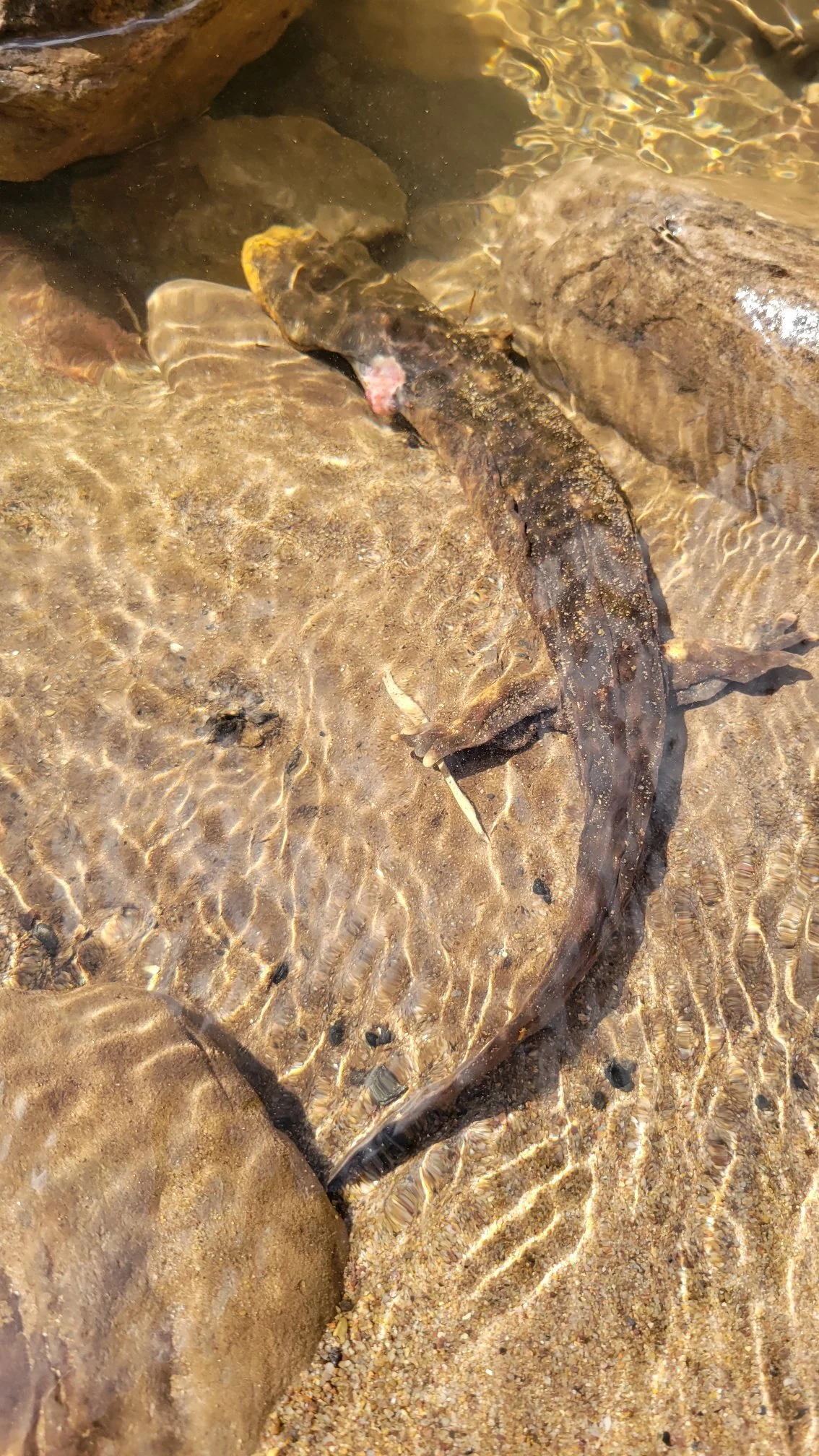
This hellbender was found a few days after Helene, with a fresh injury that may have been a result of the sudden flooding or a territory dispute with another hellbender
How Helene impacted hellbender populations
To date, the true extent of the damages Helene has had on freshwater ecosystems and hellbender populations is still unknown. Many people living near freshwater bodies have reported seeing hellbenders washed ashore and buried in piles of mud and debris during and after the flooding. Other people reported seeing hellbenders in lakes such as Beartree lake, areas not suitable for hellbenders to live.
Outside of individual displacement, numerous streams had large rocks washed miles downstream and gathered in large piles on the banks. Entire waterways shifted course entirely as a result of the massive amount of water that rushed through them. The flooding resulted in a massive amount of siltation and large amounts of pollution from the land were likely washed into the freshwater systems throughout the southeast.
The hurricane also hit during the peak breeding season for hellbenders, destroying nests and egg-laden nest boxes (concrete boxes designed to provide shelter and egg protection put in place by Virginia Tech). Surveys and research are ongoing in 2025 and there hasn’t been much data pooled from these surveys yet, but it is likely that the population took a steep decline in response to Helene’s damage.
What you can do to help hellbenders
Practice Leave No Trace principles any time you are recreating outdoors. Don’t move rocks in streams or otherwise disturb hellbender habitat. Avoid mowing or turning spill near streams to avoid introducing sediment into the water. If you catch a hellbender while fishing, gently remove the hook and release the hellbender back to the water. If you can, take a picture of the hellbender and send it to your state wildlife department so that they can document the sighting. Finally, educate yourself and your peers about these marvelous creatures we are so lucky to have in Virginia!
