Standing on Whitetop Mountain at night today, the night sky is not the same as it once was, even just a matter of decades ago. A distant warm halo on the horizon might look like the sunset, if it didn’t last well-past-midnight to the south, where mountaintop ski resorts and distant Carolina and Tennessee cities softly illuminate the distance with a burnished red-orange glow. Constellations are now forever-interrupted by the “sky caterpillar” of satellites that inches its way across our star-spangled glimpse at worlds beyond, staining the view of the cosmos for the foreseeable future. Car headlights on backroads drown the lively displays of bioluminescent critters and fungi, not only purging them from our vision but barring them from life and love, driving them towards extinction. Sometimes, it really does take darkness to see the light.
Even in the most remote places, it doesn’t take long to understand how impactful electric light is to the ecosystem. This week is International Dark Sky Week, a time to appreciate the newfangled movement to protect darkness. The human desire to (quite literally) shed light on all corners of the earth takes a toll on our planet, from plants to wildlife to our human brains. Not only does reducing your footprint help the ecosystem, it also saves energy and is fiscally wise! Darkness gets a bad rap. The night is feared because we humans are visual creatures, we need to live under the illusion that our ability to see means safety. We have to learn how to co-exist with the darkness, if we want the live-giving wonders of nocturnal wildlife, starry skies, and real nights to stay intact for future generations.
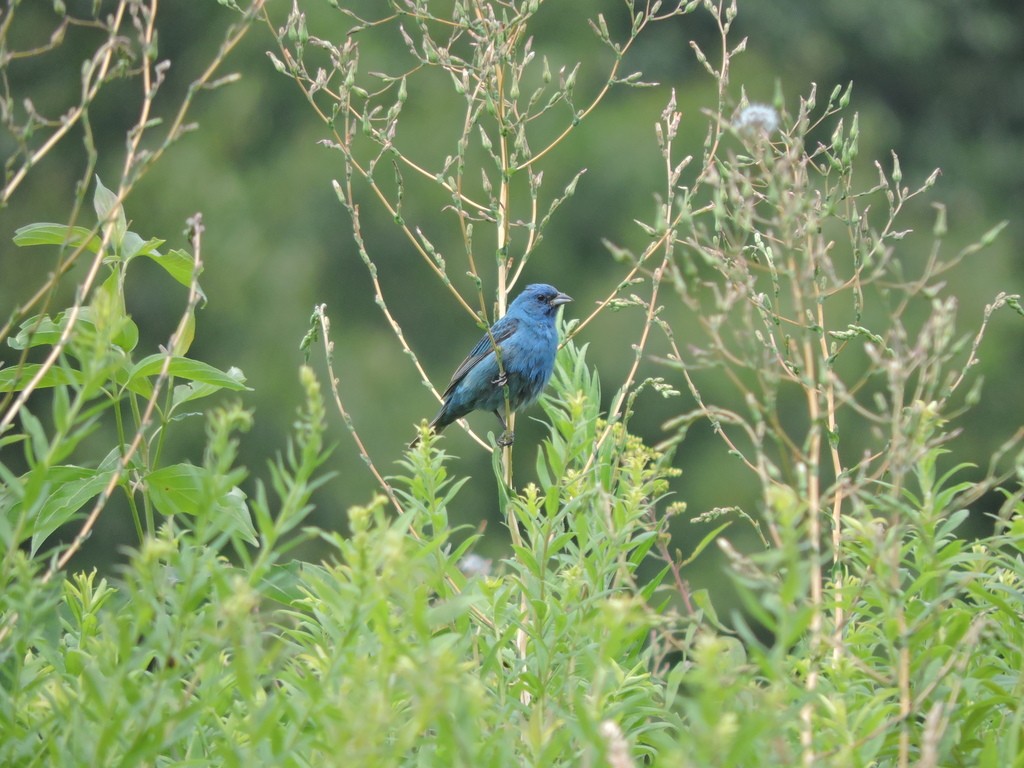
A male Indigo Bunting at Skull’s Gap on Iron Mountain, Smyth Co. VA.
Lots of unsuspected wildlife rely on dark skies to see stars. Many of our native songbirds depend on the moon and stars to migrate. These often include nonstop night migrations across most of the continent, and eventually the Gulf of Mexico and sometimes the entire Amazon Rainforest! Warblers, scarlet tanagers, wood thrushes, and hundreds of other North American species depend on these journeys under the cover of darkness to survive the winter. The Indigo Bunting (Passerina cyanea), one of Southwest Virginia’s most beloved summertime singers, must use the “North Star” Polaris to orient themselves while flying at night. The small, vibrantly-blue birds depend on (at least) this one, specific guiding star on their journey. But we are their biggest threat, setting unintentional death traps across their already-perilous route.
Around 230,000 birds are recovered each year in New York City alone, collected dead on the street after colliding with the glass of tall buildings in the “city that never sleeps.” From the spires of skyscrapers, to the most remote cabins where night owls live with picture windows, artificial lights disorient the high-flying, night-migrating birds, biologically forcing them to fly full-force into windows and, in the case of hummingbirds for example, the lights themselves. While resident birds might fly into windows occasionally because they aren’t able to identify glass, the large numbers of migratory birds killed by window collisions because their navigation gear is hijacked by our artificial lights. Without darkness, spring would have a drastically different chorus.
Birds aren’t alone. Spring peepers (or “peeping-frogs”), certain salamanders like our red-spotted newts, and nocturnal insects from dung beetles to owlet moths utilize “celestial orientation” (migration by the stars), to find their way home. This home might be the pond where they were born, or in the case of many birds and some of our small, brown moths like the Ipsilon Dart (Agrotis ipsilon), the highland forests of Central America. Lights disorient and trap them. In fact, most night-flying insects utilize the stars to orient themselves even if they are nonmigratory. Like a moth to a flame, nocturnal insects swarm to outdoor lights at night. In fact, the illustrious fluorescent glow of rural gas stations are some of the best locations to collect fascinating moths, beetles and other insects as countless tiny lives are magnetized to their darkness-shattering glory. But unfortunately, bright outdoor lights are not gentle with most animals drawn in by them. The carcasses of luna moths, sphinx moths, and thousands of other species (our post-sunset butterflies), cicadas, katydids and crickets (our night musicians), and dung beetles, mantids, and many other less-conspicuous species (who perform invaluable ecosystem services from pollination and pest-control to janitorial services) are easy to see anywhere lights remain on, consistently, night after night. In fact, insectivore predators like birds, toads, and spiders often gather around lights to feast on wayward bugs, and when pesticides are added into the equation, all of these insects and their predators are affected.
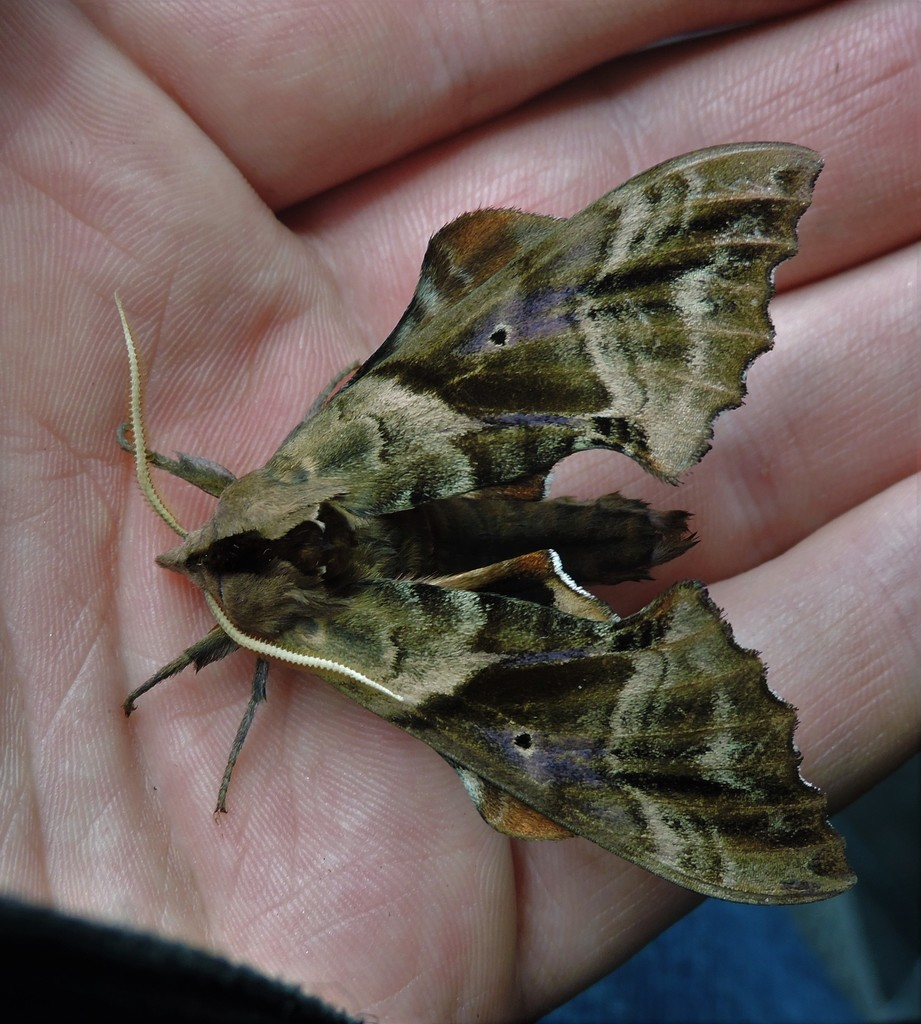
A Blinded Sphinx Moth (Paonias excaecata) attracted to campground lights at Grayson Highlands State Park.
Lights also damage bioluminescence. The sheer amount of light produced by the lights of illuminated homes, streetlights, car headlights, and even flashlights damage night vision. A nice experiment to see the effect of artificial light on our perception is by turning off your light at night in a safe place in a forest or meadow. Wait around five minutes for your eyes to adjust. You’ll start to notice shapes, and while (accurate) color vision is impossible in the darkness, our eyes are surprisingly capable of adjusting to low light conditions. When lights flash on, our eyes adjust back and our sensitivity to dim light goes away once again. Many bioluminescent creatures, from dozens of firefly species and “dismalites” (glowworm larvae of the fungus gnat Orfelia fultoni, common in moss and mud in cove forests) to foxfire mushrooms like the Jack-O’-Lantern (Omphalotus illudens), need areas with virtually no light pollution in order to use their bioluminescence, which is often necessary for reproduction. Today, they have been forced to rely on cove forests, caves and cover where ridgelines, trees, or some form of other cover cast shadows where they like to dwell.
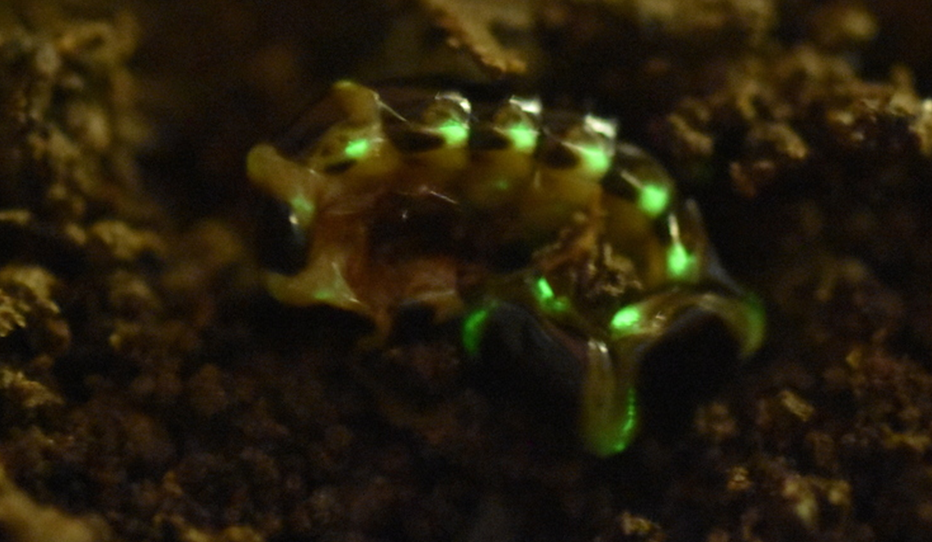
The Railroad Worm (Phengodes plumosa), a bioluminescent beetle larva that preys upon toxic millipedes, with glowing “windows” like a tiny ghost train.
The best way to avoid reducing light pollution as an individual is by covering windows and minimizing light usage at night. Always turn lights off when you are not using them, and avoid installing decorative lights. If you can’t remove lights altogether, use downward-facing, covered bulbs that do not disorient flying animals. Additionally, timed lights work well to adhere to a few hours after sunset or before sunrise without interfering with most nocturnal wildlife activity. Instead of constantly-shining “security light,” try installing a motion-sensing light so that it is only activated for brief periods of time.
On a local level, try to organize your community! Educate neighbors about the importance of dark skies, and help others (gently) to realize the gravity of an impending future without fireflies or shooting stars. DarkSky International (https://darksky.org/) is an excellent resource to learn about the ways in which you can fight light pollution in your area, with pathways to bring about legislation and municipal codes to save the darkness. They also keep a record of the dwindling places with minimal light pollution, known as “International Dark Sky Places,” with a focus on preserving a view of the stars. The Audubon Society is also involved in a number of “Lights Out” programs to help protect birds by organizing communities to turn off their lights during important migration nights (https://www.audubon.org/our-work/cities-and-towns/lights-out/existing-lights-out-programs).
Don’t be blinded by the light, we have a lot of work to do to save the darkness!