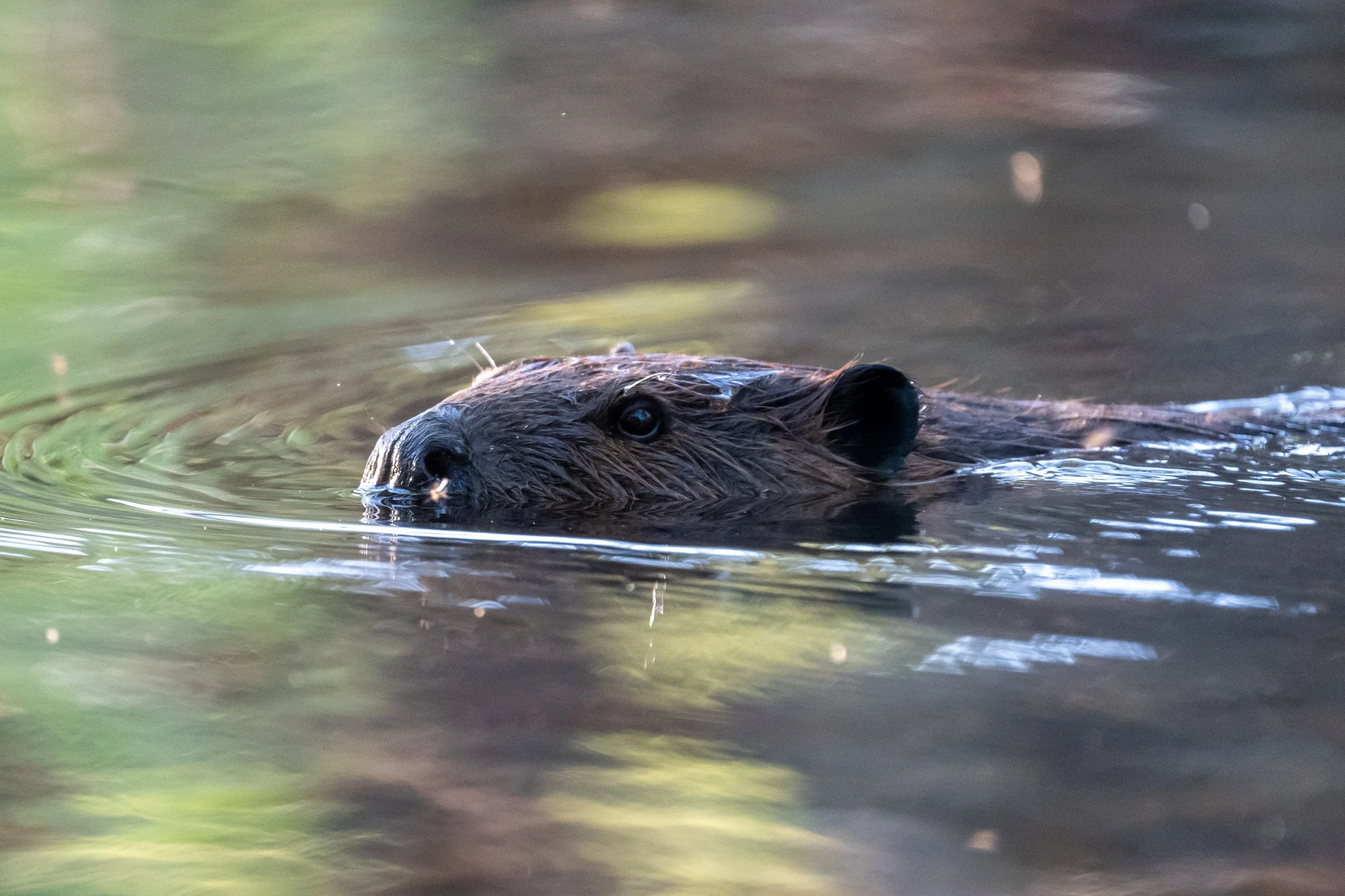
American Beaver (Castor canadensis) swimming in the Fairwood beaver ponds.
The unique location of the Blue Ridge Discovery Center provides an equally unique opportunity to see North America’s, and possibly the entire world’s, most famous “ecosystem engineer.” Remote headwaters of the Jefferson National Forest are some of the last refuges of American Beaver (Castor canadensis) in Virginia. The species is still common, considered a “nuisance species” statewide. However, remote mountain valleys provide one of the few places where beavers are able to live in their complete, complex architectural systems (dams, lodges, etc.) now absent from most of the eastern United States.
Our beaver-focused school program is a well-beloved opportunity for many kids to experience a brief but meaningful encounter with wildlife, especially in the late winter or early spring when beaver activity is high. Kids begin by learning about “keystone species,” and how families of beavers work together to construct entire ecosystems that exist temporarily, but benefit thousands of species of plants & animals even after the beavers move from their compounds to fresher forests. We also discuss beaver biology, and their unique feeding habits by stripping twigs and tree trunks of cambium, the nutritious inner-layer of bark. By showing them specimens, kids have hands-on experience with these animals. We discuss the forever-growing teeth of beavers: they look like they need to brush their teeth, but it’s really just extra-strong, reinforced calcium that makes the teeth look yellow-brown, their waterproof layers of fur, and their large, paddle-shaped tails.
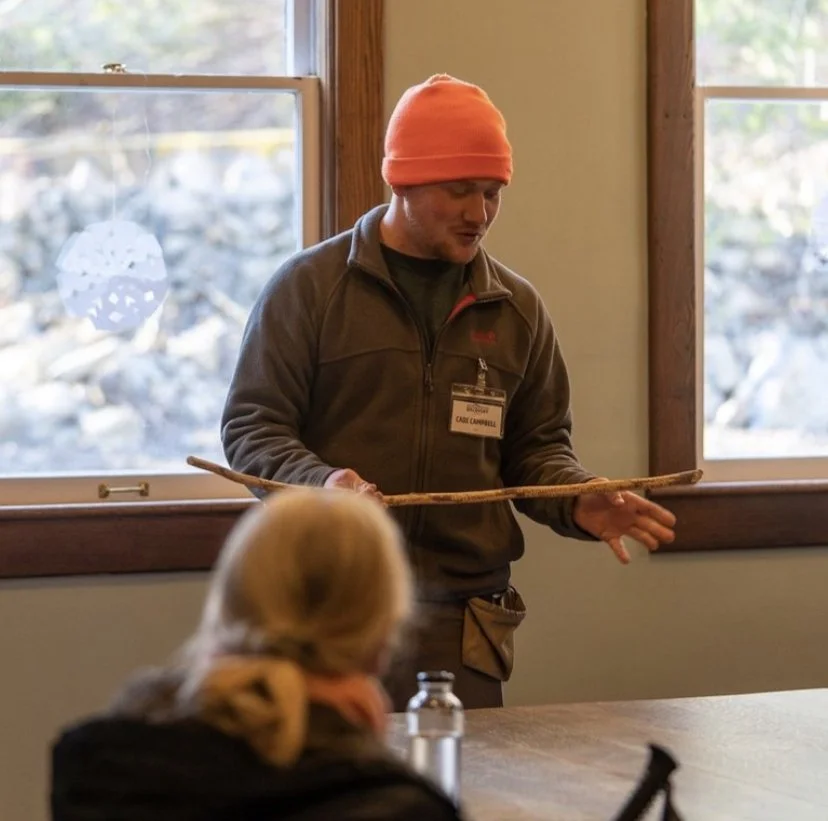
Naturalist educator Cade Campbell teaches a group about the identification of beaver signs on a willow branch.
We teach briefly about their communication, their tracks & signs, and their complex history in Virginia - including their extirpation (local extinction) in the 18th century due to the fur trade demand in Europe, but that’s better discussed on our following “field trip.” We show them artifacts from the beaver pond habitats, including an abandoned conibear trap found in a local creek, left behind by more recent trappers. Sometimes, we give school groups an opportunity to attempt building beaver dams with sticks, rocks and mud in metal trays, and then test their constructions by pouring a “river” of water upstream of their construction.
After our time in the classroom, we climb into the van and begin a journey down Fairwood Valley toward the beaver ponds. We usually listen to CDs of the Junior Appalachian Musicians program, playing traditional mountain music and may encounter wildlife crossing the road in the national forest, which have included ravens, bears, owls and foxes on different occasions in the past. Sometimes, we will stop in specific gravel pull-offs along the trailheads to discuss a particular animal or blooming plants (i.e. flame azaleas) spotted by the naturalist educators enroute, especially in former or current “Blue Ridge beaver meadows” - the extremely rare and specialized short-lived grassland types left behind by a drained beaver pond.
School groups aren’t the only chances the Discovery Center provides to see this habitat! At the recent Mount Rogers Winter Naturalist Rally, nature enthusiasts of all ages intrepidly crossed the dam to a lodge during the wildlife tracking program. Many of our programs rely on the open meadows and still water generated by the beavers, from wildflowers and dragonflies to cultural history and fly fishing. University groups, itinerant researchers, and amateur naturalists such as birders and herpers have all benefited from the Discovery Center’s ties and long-term association with these specialized wetlands.
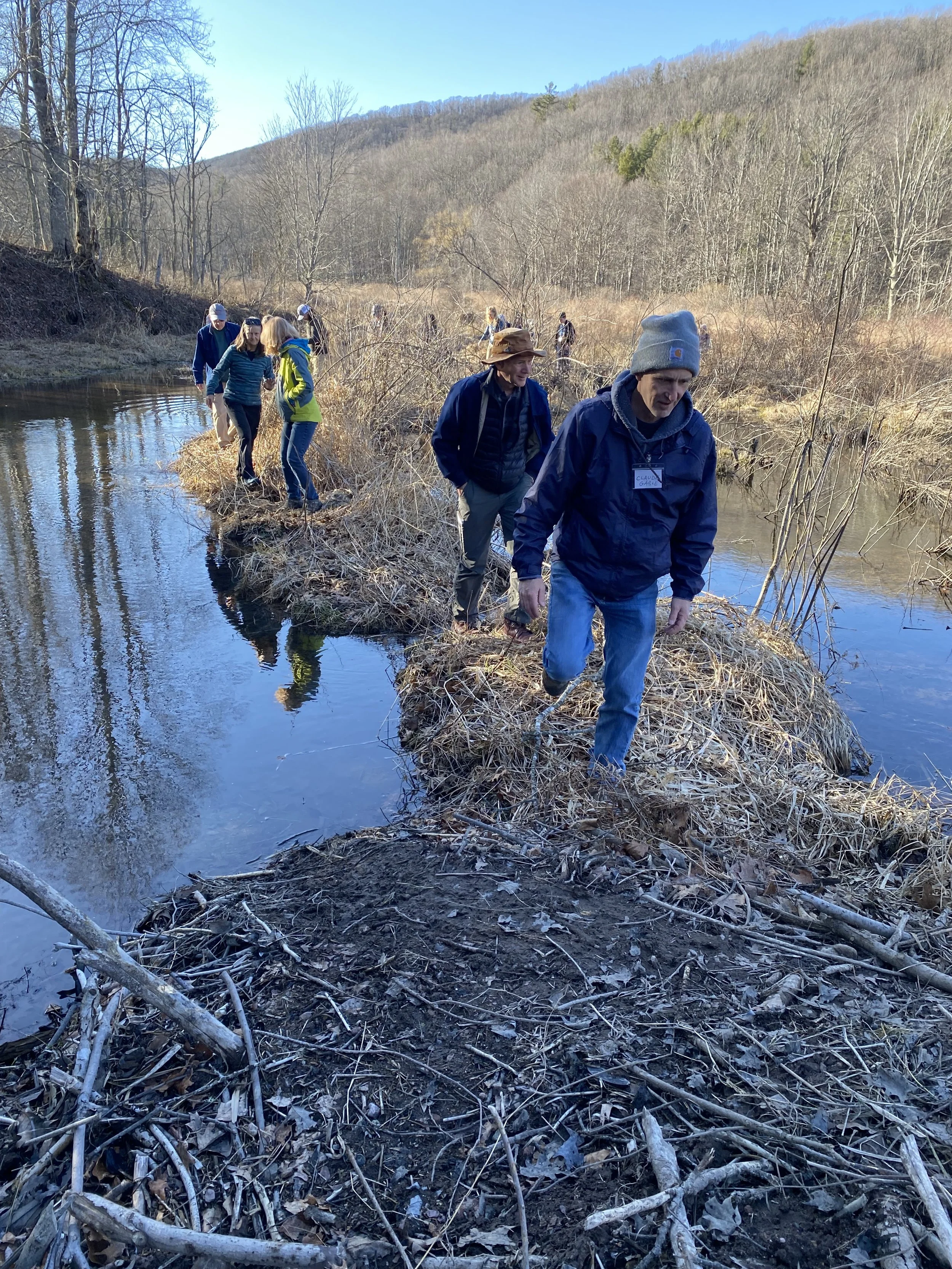
The Mount Rogers Winter Naturalist Rally “Wildlife Tracking & Signs” program crossing a beaver dam to a newly-constructed beaver lodge.
At the beaver ponds, participants have a chance to walk across a real, active beaver dam (sometimes multiple), and test its structural integrity. An entire class of students may jump up and down on an active, well-built beaver dam (tested first by naturalist-educators) without any shift or damage to its structural integrity - and without disturbing any inhabitants. Often, the lodge can be accessed by “land bridges,” sometimes merged with a dam or dam-like structure. We discuss how the dam is only accessible by underwater tunnels, and how these entrances are always equal to the level of the pond, held steady by constant, devoted maintenance of the dam. This way, the beavers will always have a dry, spacious den inside of the lodge regardless of the water level.
Often, fresh-splattered mud with beaver tracks provides an excellent, tangible step-by-step tutorial of how the lodge is constructed left behind by the beavers themselves! Likewise, chewed branches and spherical, sawdust-filled scat provide clues about their diet. If our group is extraordinarily lucky, beavers will be spotted working. Most often, they are feeding on cambium or bunches of marsh plant foliage or roots, especially from the many small silky-willow trees growing along the water’s edge. Usually, when beavers realize they are being observed, they disappear underwater with a loud, reverberating tail slap (like a canoe paddle being slammed against the water’s surface) to warn other beavers and other wetland animals of a potential predator. River otters (the nemesis of beavers, for their ability to enter the lodges and steal unsupervised kits), muskrats, and minks and their signs are also potential subjects of nature study at this site, although beavers reign supreme as our best example of a keystone species in these beloved ecosystems they create.
While so much environmental destruction can be found across Virginia where land is disturbed, this program is an excellent chance for students to observe habitat that is positively altered. Not destructively, nor is it altered by humans. Instead, it is a place where wild animals build something beautiful and (at least in modern times) is rare and at the very least difficult to experience with the same freedom that was afforded to previous generations in these mountains. In years when trappers leave the right section of stream alone, we gain this incredible, ephemeral teaching tool to empower the next generation(s) of stewards in Southwest Virginia!